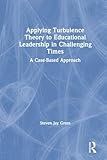
Applying turbulence theory to educational leadership in challenging times : a case-based approach / Steven Jay Gross.
By: Gross, Steven Jay [author.]
Publisher: New York : Routledge, Taylor & Francis Group, 2020Description: xi, 192 pages : illustrations ; 24 cmContent type: text Media type: unmediated Carrier type: volumeISBN: 9781138046702; 9781138046726Subject(s): Educational leadership | Educational leadership -- Case studies | School management and organization | School management and organization -- Case studies | Turbulence TheoryDDC classification: Grad 371.2 LOC classification: LB2806 | .G75 2020| Item type | Current location | Home library | Collection | Call number | Vol info | Copy number | Status | Notes | Date due | Barcode | Item holds |
|---|---|---|---|---|---|---|---|---|---|---|---|
| CIRCULATION BOOK | GRADUATE LIBRARY | GRADUATE LIBRARY CIRCULATION SECTION | NON-FICTION | Grad 371.2 G878 2020 c.2 (Browse shelf) | 11016 | c.2 | Available | Catalog by J.S. 03/04/25 | 11016 | ||
| CIRCULATION BOOK | GRADUATE LIBRARY | GRADUATE LIBRARY CIRCULATION SECTION | NON-FICTION | Grad 371.2 G878 2020 (Browse shelf) | 9878 | Available | 9878 |
Includes bibliographical references and index.
Part 1: Understanding and applying turbulence theory -- Orienting yourself for the journey into a turbulent educational landscape -- Examining Turbulence Theory -- Applying Turbulence Theory to respond effectively to critical incidents -- Part 2: Putting Turbulence Theory to work: the cases -- Central Office Administrators: encouraging local initiative versus control -- Principals: democratic ethical leadership versus behaviors of conventional school leaders -- Teachers: individual agency versus conformity -- Students: equity versus a narrow equality -- Families and communities: citizenship versus consumerism -- Part 3: Conclusion -- Next steps in our journey of understanding and applying Turbulence Theory.
"In our increasingly complex world, the turbulent forces affecting educators have become vastly more dynamic, creating complex challenges but, perhaps paradoxically, also unique opportunities. Reframing how to understand the drivers of turbulence, Applying Turbulence Theory to Educational Leadership in Challenging Times provides aspiring and practicing educational leaders with the theory and tools for understanding Turbulence Theory and its application to school contexts. Renowned author Steven Jay Gross explores how you can apply turbulence theory to respond to critical incidents, as well as how to address the tensions across various stakeholders, including the central office, principals, teachers, students, families and communities. With over 20 innovative, case-based examples and discussion questions, this book explores how turbulence can be leveraged or minimized to increase creative opportunity and address dilemmas in schools"-- Provided by publisher.
There are no comments for this item.